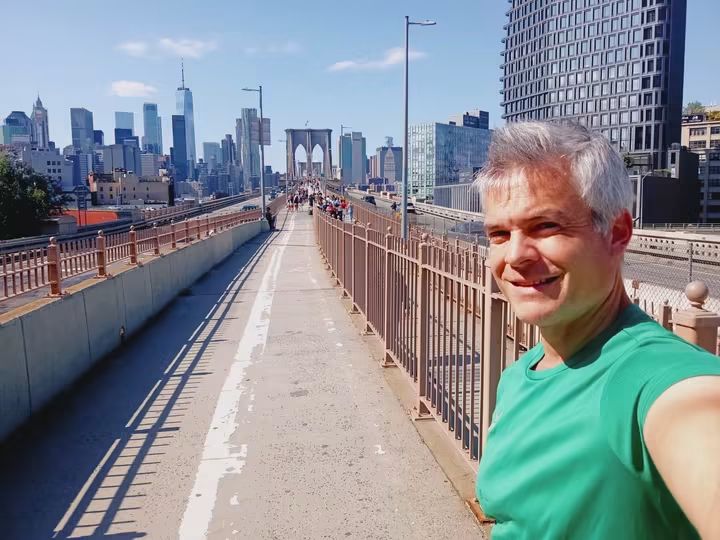
Brooklyn NYC
Some budget travelers are genuine. Genuine ones paint a realistic picture of circling the globe and enjoying the experience as you save dough.
Some budget travelers suffer quite a bit or are less than genuine.
Can you circle the globe on almost no money?
No.
I can verify this. I tried it. Traveling requires exchanging money for various products and services.
Budget travelers spend enough money to enjoy a decent quality of travel. At least genuine budget travelers share this honest perspective.
The Problem with Traveling on Almost Zero Dollars
At best you suffer miserably.
At worst you flat out lie by sharing completely unrealistic expectations as the world judges it.
I’ll give you an example of both.
Miserable Travels
Kelli and I met a Russian expat couple in Sihanoukville Cambodia.
The kind and frank-speaking – they were Russian after all – couple owned a vegetarian restaurant on the beach.
The husband noted coming across expats who bragged about consuming a $2 USD big seafood dinner in town. 24 hours later, the expats showed up pale-faced, sweating and sheepish, professing how “Maybe buying a big seafood dinner for $2 USD was not the best idea.”
Even in a place like Cambodia, paying 2 bucks for a big dinner flashes a massive red flag. Dirt cheap seafood is usually seafood the restaurant owner sold after the seafood did not sell the prior day. Where was the cheap seafood? Why sitting out in the baking sun and steamy humidity for 10 hours, of course!
The bragging budget travelers bought one thing on the cheap: giardia. Save almost every penny. Destroy your digestive tract. Suffer horrifically for hours. Why? Dropping $6 to $8 to $10 USD for a proper meal was “too expensive”.
You purchased the right to vomit like Linda Blair from The Exorcist for 12 hours on and off. Was the $2 massive seafood dinner worth it? Did you enjoy sprinting to the bowl for half a day? Do ethical travel bloggers guide budget travelers to buy 2 buck dinners in developing countries with sometimes non-existent hygiene in various regions?
When you are trying to get something for nothing you buy almost nothing of value. The product or service typically bites you on the ass – or flies out of it violently – sooner than later.
Pay enough money to be comfortable but not enough to piss away your scratch.
But make no mistake about it.
Kelli and I pay $2 USD to $3 USD per person for delicious, nutritious, satiating vegetarian meals at Jai restaurants all over Thailand. No one speaks English. Farang are rare commodities. We speak a few words in Thai to order. Hygiene? Top notch. The food sells out daily. This means no food sits out until the following day.
The delicious, properly prepared, safe to eat, cheap food is in the neighborhoods most tourists skip.
Most tourists avoid these type of spots because it feels too uncomfortable to go there. Awkwardness usually arises in the mind. Embarrassment about not being able to communicate seamlessly on the first try scares most tourists from getting the best food around for the cheapest price.
Overcome that garbage in your mind. Travel on the cheap. Get the best experience as possible.
Get lost. Explore. Research thoroughly online. Go beyond the common top 10 lists.
Go the extra travel mile to enjoy your time abroad while saving money.
ENJOY your budget travels.
Skewer for Dinner?
I recall seeing a vlogger claim how one can buy a whole dinner for 30 cents in Thailand.
He dropped his 10 Baht to purchase a skewer of beef. He made the meat look hearty, satiating, entirely filling.
But I spent 2 years in Thailand on and off. I know what the street stall skewers look like. Even an anorexic Olive Oil would not call a single skewer dinner. This would be like the vlogger saying you can buy dinner on a budget in the USA for $1 USD. He proceeds to purchase a tiny bag of Cheez-Its and downs those suckers with a smile.
Be realistic.
Budget travelers spend less money than most. But this does not mean spending almost nothing for laughably meager returns.
Fill your gut. Spend 6 bucks on dinner at the local place frequented mainly by Vietnamese folks in Saigon. Yeah; the one deep down the alley all the tourists ignore on their way to the popular spots.
How Can You Travel on a Budget?
Be shrewd yet discerning.
Invest a little money but enough to create a high quality of life.
Live high off of the hog without paying for the entire hog yourself. Pay a little bit to get solid cuts that are not the most choice but still excellent. If you try to get anything for free you will probably be eating slimy entrails. Sorry; but this is how budget travel works from a person who has not stopped traveling the world since 2011.
I travel on a budget because my wife and I value a few things. We love circling the globe.
We pay money for:
- gas (we own a car in the States)
- car repairs
- flight tickets
- train tickets
- bus tickets
- dolmus/colectivo local travel (I used Turkish and Central American transport methods for two of our favorite ways to get around in these countries/regions)
- taxi fairs or ride share fairs
- shuttle tickets
- food
However, Kelli and I rarely pay for hotels or apartments. We house sit.
Since we’ve been in California we’ve enjoyed a high quality of life living in posh pads. We trade in-demand services to live mortgage-free in about the most expensive place in the world.
For example, we house sat for a couple in Redwood City; a 5 minute walk from Atherton in Silicon Valley. Atherton is one of the most expensive neighborhoods in the United States and world. The 1400 square foot home lists at $1.7 million USD. Property? A postage stamp. We lived there rent-free / mortgage-free because we’ve become highly skilled at:
- caring for pets
- caring for homes
- calmly solving the inevitable problems triggered when you live in 130 homes and care for hundreds of various animals all over the globe in radically different environments with an array of obstacles, from climate, to local wildlife, to country customs and right on down the list
I cannot estimate how much we save on mortgage payments. But each house where we’ve done a sit in California has ranged from $1 million USD to $4 million USD since January.
This is an example of experiencing a high quality of life on the cheap or even for free.
BUT…..we have only done house sits since 2014, pretty much. We worked to gain invaluable experience over 12 years of our lives to reach this point.
We are house sitting for free but developed a highly nuanced skill set.
This is why people with $5,000,000 mansions hand us the keys to their home to care for their beloved pets.
Short term travelers can live mortgage-free through house sitting to build their resume. Gain experience. Develop the skills of tending to houses and caring for pets. Travel rent-free. Travel mortgage-free.
I want to share a few legitimate budget travel tips:
- shop at budget grocery stores; prepare food at your lodging (basic kitchen required)
- travel with a carry on and fly budget (but beware various budget airline fees; do your homework thoroughly beforehand)
- travel like locals do to save scratch (find out how they get around)
- be a pedestrian to get exercise and save money
- dig a bit for inexpensive hotels but always read reviews to prevent unpleasant experiences; pay up a little bit for clean, safe surroundings
- rent inexpensive apartments that are a little distance outside of town
- look into house sitting
As for actual tourist stuff my favorite thing to do is 100% free: explore neighborhoods by foot without your phone.
Get lost then find your way.
Ask locals how to get around.
Develop your intuition. Look into your mind for guidance.
I love exploring neighborhoods without a set goal in mind. Not only is it perfect for budget travelers – helping you avoid expensive tours – it morphs you into a super traveler.
A super traveler is one who feels fully comfortable anywhere in the world because walking off of the beaten path feels familiar, just like home.
Conclusion
Save money.
Enjoy your travels.
Never sacrifice quality of life for a few bucks.
Learn how locals eat and get around. Enjoy the best food on the cheap. Live within your purse as you seamlessly get around.
Spend enough money to enjoy your travels but not enough to burn through your wallet.
Related posts:
 How Travel Bloggers Make Money through Sponsored Posts
 How Travel Blogs Make Money: 10 Monetization Tips
 7 Travel Challenges
 How to Make Money through Your Travel Blog with Unconventional Methods
 Why Traveling the World May Be the Best Gift for Your Kids
 What Is One Benefit to Not Doing Extensive Travel Research?
 Should You Travel During the Low Season?
 Blogging From Paradise: How to Retire to a Life of Travel and Blogging
